Every job below is one we do ourselves across New Smyrna Beach.
We pour driveways four inches thick for regular cars, six inches if you're parking a boat trailer or RV on it. We cut control joints every ten to twelve feet so the slab decides where to crack instead of guessing on its own. Sandy soil around New Smyrna Beach compacts fast, but we still run a compaction check before any concrete goes down.
A patio slab doesn't carry the load a driveway does, so we can run a broom finish or stamp it without worrying about tire wear. We slope it away from the house at a quarter inch per foot, minimum, so water doesn't sit against your slider door. Shade from live oaks keeps some patios green with algae faster than open ones, and an integral sealer slows that down.
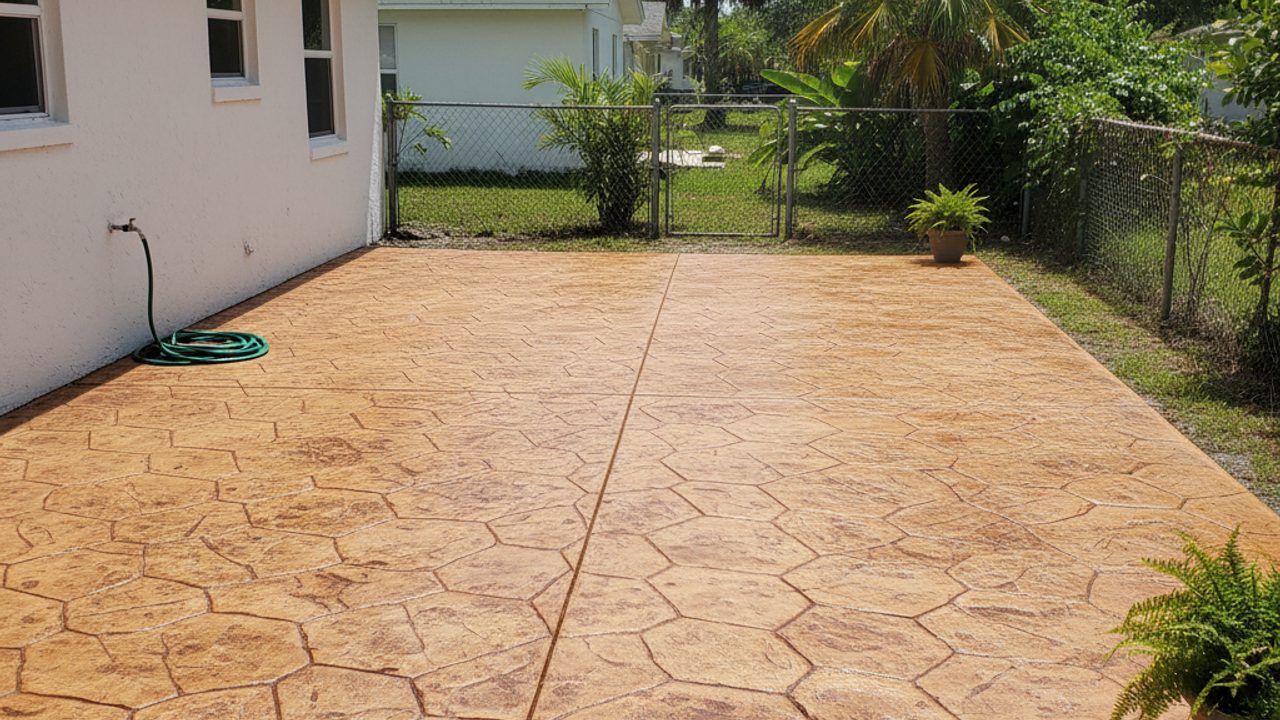
Stamped concrete gets you the look of pavers or slate without the joints where weeds come up. We lay down a color hardener and release agent before stamping, then seal it once it's cured, usually around 28 days. Coastal humidity here means we watch that sealing window closely, too early and it clouds.
Slab foundations for additions, sheds and garages need a vapor barrier under them in this water table, or moisture wicks up through the concrete for years. We set rebar on chairs to hold it at mid-slab depth, not mesh laid on the dirt and stepped flat during the pour. Get the base compaction wrong here and you'll see it as cracking within the first year.
Spalling, popouts and hairline cracks are usually surface issues we can grind out and patch. A slab that's settled or heaved is a different problem, and sometimes the fix is mudjacking or foam injection instead of a patch that won't hold. We'll tell you straight if a section needs to come out and get repoured instead of patched.
Sidewalks and walkways get the same joint spacing rules as a driveway, just narrower and thinner, usually four inches of 3,000 PSI mix. Tree roots from oaks and palms lift more walkways around here than anything else. If roots already got under yours, we'll talk about root pruning or a floating pour before we replace anything.
Pool decks need a broom or knockdown texture, never a smooth trowel finish, because wet concrete around a pool gets slick fast. We keep the slope moving water toward deck drains and away from the coping. Salt from the beach air pits plain gray concrete over time, so we usually recommend a sealer here that a landlocked patio doesn't need.
If your driveway or patio has surface scaling but the slab itself is sound, resurfacing with a polymer overlay can save you a full tear-out. It won't fix a slab that's cracked through or settling, that's a repour situation. We check the existing slab first before recommending resurfacing over replacing it.
Exposed aggregate gives you a non-slip, textured finish by washing off the top layer of paste before it fully sets, showing the stone underneath. It holds up well on driveways and pool decks where a smooth finish gets slippery. Timing the wash-off right, usually a few hours after the pour, separates a good exposed finish from a blotchy one.
Landscape curbing gives flower beds and driveway edges a clean line without the maintenance of edging every season. We can run it straight or curved, and stamp or color it to match the driveway. It's a smaller pour, but the same rules on control joints and cure time still apply.
Four steps, and no surprises in any of them.
You tell us what you want doing, we look at what is actually there, and we ask the awkward questions early.
In writing, itemised, free. If something might add cost later we flag it now rather than at the end.
Same crew throughout. We cover your floors, keep the dust down and tidy up before we leave each day.
You point out anything you are not happy with and we fix it before the invoice, not after.
We pour concrete throughout this part of the Florida coast, not just in New Smyrna Beach.
Questions that come up once a concrete project actually gets underway.
Describe the problem and we will tell you what it probably is. No obligation.